
May
okay so treble stitch basics
Right so the treble stitch is taller than a double crochet and honestly I didn’t even bother learning it properly until like spring 2022 when I was making this blanket and got bored with just doing double crochet rows forever. I think I was using Red Heart Super Saver in that grey color, the one that’s like… charcoal or whatever they call it. Anyway treble stitches are good when you want height without doing a million rows.
The abbreviation is TR or sometimes you’ll see it as tc but mostly tr. In UK patterns they call it something different but I don’t really work from UK patterns so honestly can’t remember what.
how to actually do the stitch
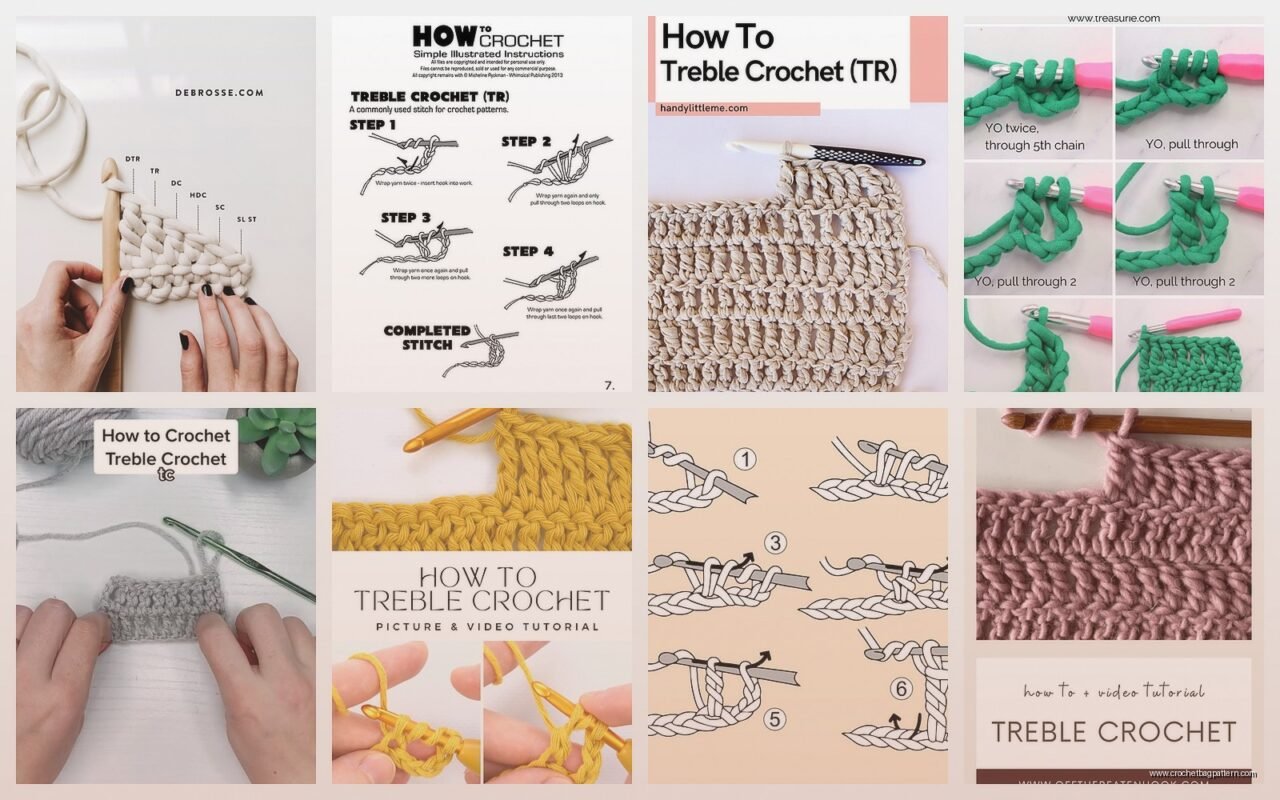
So you’re gonna yarn over TWICE before you even put your hook into the stitch. That’s the main thing that makes it different from double crochet where you only yarn over once. Two times. Wrap that yarn around your hook two times.
Then you insert your hook into whatever stitch you’re working into. If you’re starting a new row you usually chain 3 or 4 at the beginning because treble stitches are tall and you need that height. I usually do 3 chains but some people are really specific about doing 4.
Once your hook is in the stitch, yarn over again and pull through. Now you should have 4 loops on your hook total. This is where it gets a bit repetitive but like in a meditative way I guess? Or maybe that’s just me trying to make it sound less tedious than it actually is.
Yarn over and pull through the first 2 loops on your hook. Now you have 3 loops left.
Yarn over again and pull through 2 loops. Now you have 2 loops left.
Yarn over one more time and pull through the last 2 loops. Done. That’s one treble stitch.
It’s basically like doing a double crochet but with an extra step at the beginning and an extra yarn over pull through situation in the middle.
the thing that annoyed me
Honestly the most annoying part about treble stitches is that they use up SO much more yarn than you think they will. I was making this scarf last summer, like July 2024, and I was using Caron Simply Soft in that burgundy color because it was on sale at Michaels. I thought I had enough yarn. I measured, I did math, I thought I was being responsible. But treble stitches eat yarn like crazy because they’re so tall and you’re doing all those yarn overs. I ran out with like 8 inches left to go on the scarf and had to order more yarn online and wait for shipping and it was just frustrating.
So if you’re planning a project with treble stitches, buy more yarn than you think you need. Seriously.
starting a row of treble stitches
When you’re starting a new row, you gotta chain up. Most patterns say chain 3 and that counts as your first treble stitch. Some say chain 4. I’ve tried both and honestly I can’t really tell the difference in the finished project so I just do whatever the pattern says or if I’m freestyling I do 3.
If your chain counts as the first stitch, you skip the first actual stitch in the row below and work your first real treble into the second stitch. Then at the end of the row when you come back, you work your last treble into the top of that turning chain from the previous row. This creates a straight edge instead of a weird slanted mess.
If your turning chain DOESN’T count as a stitch (some patterns do it this way), then you work a treble into the first stitch of the row. It’s really just about what the pattern tells you to do.
where to insert your hook
You insert your hook under both loops of the stitch below, same as with any basic crochet stitch. Sometimes patterns will tell you to go through the back loop only or front loop only but standard is both loops.
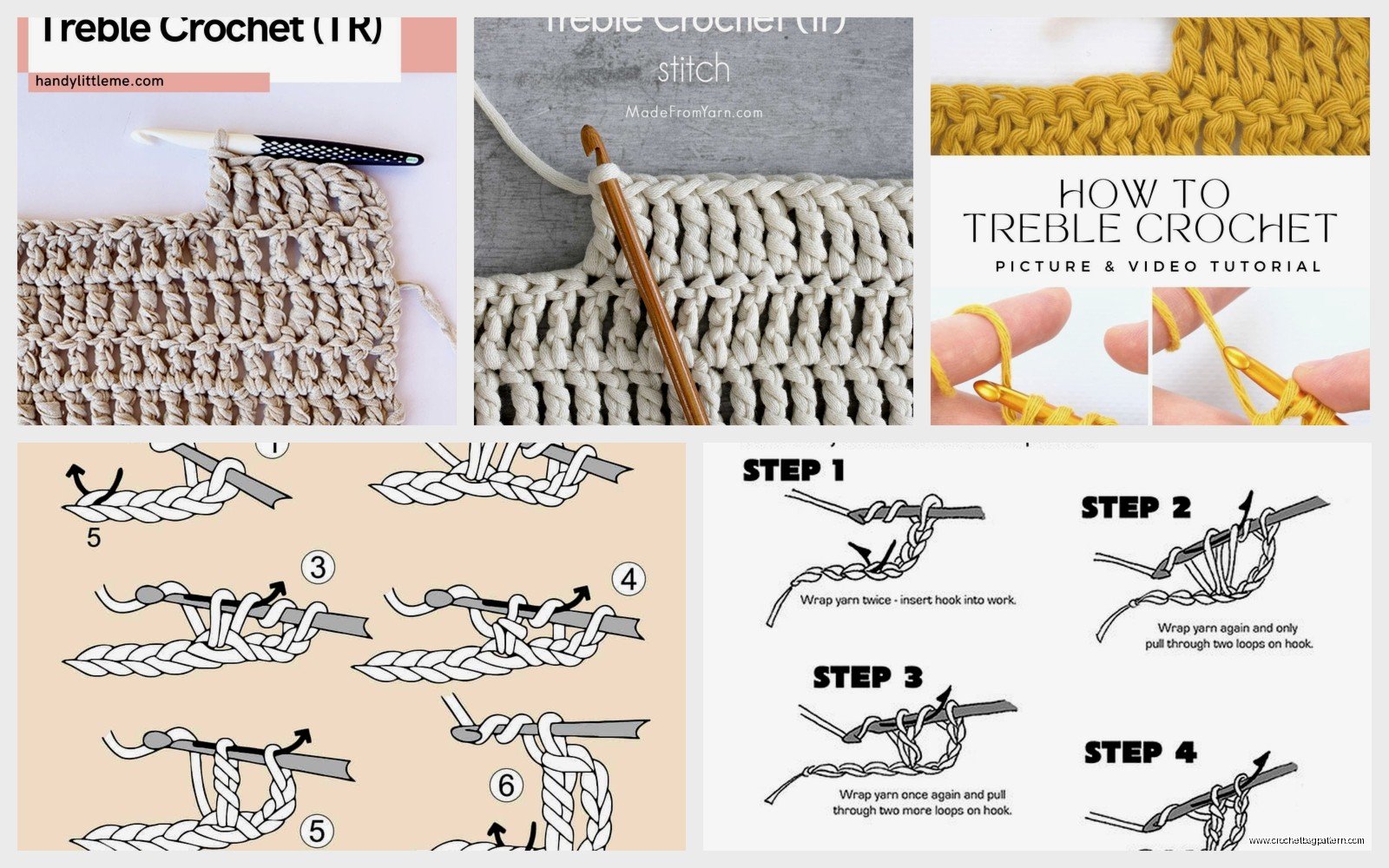
The top of a treble stitch looks like a little V when you’re looking down at it from above. Your hook goes under that V, under both strands of yarn that make up that V shape.
tension stuff
My tension with treble stitches is always looser than with shorter stitches. I think it’s because there’s more yarn involved in each stitch so there’s more opportunity for it to get loose and floppy. Or maybe I just haven’t practiced enough, I dunno.
If your treble stitches are looking really loose and gappy, try going down a hook size. I usually use a 5mm hook with worsted weight yarn for double crochet but I’ll sometimes use a 4.5mm for treble stitches in the same yarn. It makes them tighter and neater.
Also the yarn you use makes a difference. I tried doing treble stitches with Lion Brand Wool-Ease once and it was fine, pretty standard. But then I tried with some cheap acrylic yarn from Walmart (I think it was their Mainstays brand?) and it was so splitty and annoying. The yarn would split apart when I was trying to do all those yarn overs and pull throughs and I kept accidentally going through only part of the yarn strand instead of the whole thing.
counting your stitches
With treble stitches you really gotta pay attention to your stitch count because they’re tall enough that it’s easy to accidentally skip stitches or add extra ones without noticing right away. I count at the end of every row when I’m doing trebles. With double crochet I can get away with being lazy about counting but not with these.
The top of each treble stitch is that V shape I mentioned. Count the Vs. If you’re supposed to have 30 stitches, count 30 Vs across your row including the turning chain if it counts as a stitch.
variations and combinations
Once you know the basic treble stitch you can do clusters and shells and all sorts of stuff. A treble cluster is when you work multiple treble stitches into the same stitch below but you don’t complete them all the way. You leave the last loop of each one on your hook and then yarn over and pull through all the loops at once. It makes a little fan or shell shape.
I made this baby blanket in like… I think it was winter of 2023? I was watching that show The Bear while I worked on it, the one with the chef—anyway I used a pattern that had treble clusters and it created this really nice textured effect. The yarn was Bernat Baby Blanket in that pale yellow color. That yarn is super thick though so the trebles worked up really fast.
treble in the round
If you’re doing treble stitches in the round like for a hat or a circular blanket, you start with a chain 3 or 4 instead of the regular chain 2 you’d do for double crochet. Then you work your trebles around and when you get back to the beginning you slip stitch into the top of that starting chain.
The increases are different too. For double crochet in the round you usually do 2 dc in one stitch to increase. For treble stitches you do 2 tr in one stitch. Pretty straightforward.
what treble stitches are good for
I use treble stitches when I want a project to work up faster than it would with shorter stitches. They’re good for blankets where you want drape and flow instead of a really dense fabric. Shawls too.
They’re not great for amigurumi or anything that needs to be stuffed because the stitches are too open and loose. You’d see the stuffing through the gaps. Same reason I wouldn’t use them for a bag that needs to hold things.
But for scarves, blankets, shawls, even some sweaters—they’re perfect. They create a fabric that has movement to it instead of being stiff.
fixing mistakes
If you mess up a treble stitch you just pull your hook out and tug on the working yarn to unravel back to where the mistake is. Same as with any crochet stitch really. The annoying part is that because trebles are so tall you’re unraveling MORE yarn when you rip back. Like if you mess up and have to rip out 5 stitches, that’s a lot more yarn to unravel than if you were doing 5 single crochet stitches.
My cat knocked over my coffee onto a project once while I was in the middle of a row of trebles and I just… had to start that whole section over. It was a mess. The coffee didn’t stain the yarn too bad because it was dark brown yarn anyway (I think Vanna’s Choice in chocolate?) but the wet yarn was impossible to work with so I had to let it dry first.
double treble and triple treble
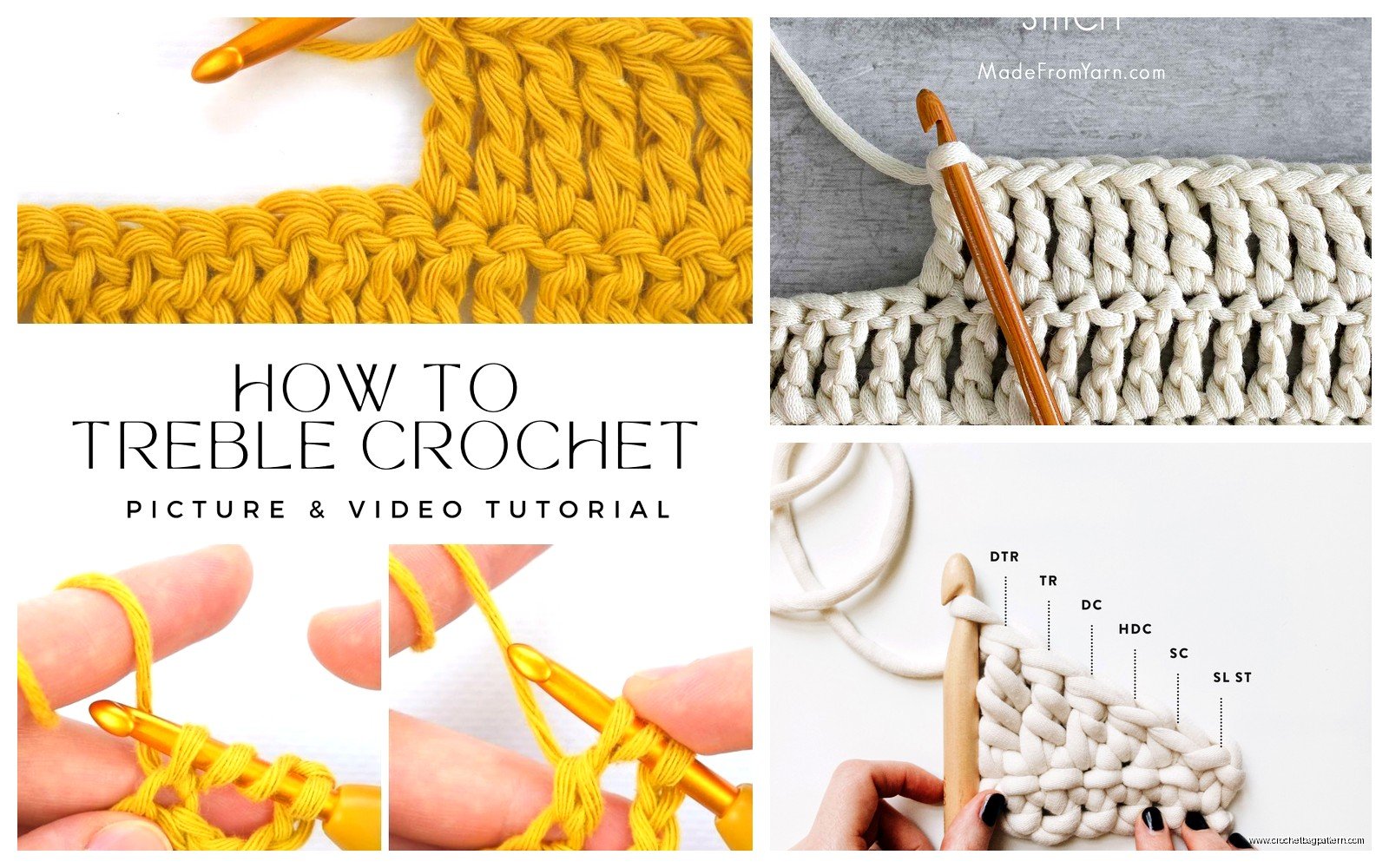
There are even taller versions if you want to get wild. Double treble (dtr) is when you yarn over THREE times at the start instead of two. Then you do the same pull through 2 loops process but you do it more times because you have more loops on your hook.
Triple treble is yarn over FOUR times. I’ve only used triple treble once and it was for this weird experimental wall hanging thing that I never actually finished. The stitches were so tall they looked almost ridiculous but that was kind of the point.
Most of the time regular treble is tall enough for whatever you’re trying to do though.
reading patterns with trebles
When a pattern says something like “tr in each st across” it means you’re doing one treble stitch in each stitch from the previous row. Pretty simple.
If it says “2 tr in next st” that means you’re putting two treble stitches into the same stitch below, which is an increase.
“Tr2tog” means treble 2 together which is a decrease. You start two treble stitches but don’t complete them, leaving the last loop of each on your hook, then yarn over and pull through all the loops at once to join them together into one stitch.
Sometimes patterns will have you work trebles into chain spaces instead of into actual stitches. Like “tr in ch-2 sp” means you put your hook into that gap created by a chain 2 from the previous row instead of into a stitch. This creates a lacier more open fabric.
practice suggestions
If you’re just learning trebles I’d suggest making a simple scarf or dishcloth just to practice the motion until it feels natural. I learned by making a scarf that I messed up so many times I eventually just unraveled the whole thing and used the yarn for something else. But that’s how you learn I guess.
Start with a foundation chain of like 20 or 25 stitches. Not too many because you’re just practicing. Chain 3 for your turning chain, then work trebles across. When you get to the end, turn, chain 3 again, and work back across. Do this for like 10 or 15 rows until the motion feels automatic.
Use a light colored yarn so you can see your stitches clearly. I tried practicing with black yarn once and couldn’t see what I was doing at all. Ended up switching to white Red Heart Super Saver and it was so much easier.
common problems
If your fabric is getting wider as you go, you’re probably adding stitches accidentally. Count more often and make sure you’re not working into the turning chain AND the first stitch of the row if your turning chain counts as a stitch.
If it’s getting narrower, you’re probably missing stitches at the ends of rows. Make sure you’re working into that last stitch and into the top of the turning chain when you’re supposed to.
If your stitches look twisted or weird, you might be inserting your hook in the wrong place. Should go under both loops of the V at the top of each stitch.
If your turning chain edge looks loose and messy, try chaining one less than the pattern says. Or just accept that turning chain edges are kind of ugly sometimes and plan to add a border later to clean it up.
working into a foundation chain
When you’re working your first row of trebles into a foundation chain, you insert your hook into the 4th or 5th chain from your hook depending on whether you’re counting that starting chain as the first stitch or not.
The foundation chain needs to be loose enough that you can easily get your hook through but not so loose that it’s floppy and stretched out. I usually go up a hook size just for the foundation chain and then switch back to my regular size for the actual rows but some people think that’s unnecessary.
That first row is always the most annoying because working into a chain is more awkward than working into actual stitches. Once you get past that first row it gets easier.
Anyway that’s basically everything I know about treble stitches. They’re not complicated once you get the rhythm down it’s just yarn over twice, insert hook, pull through, then yarn over and pull through 2 loops three times. The height takes some getting used to and they eat yarn but they’re useful for lots of projects.
