
Apr
Getting Started with Entrelac Blocks
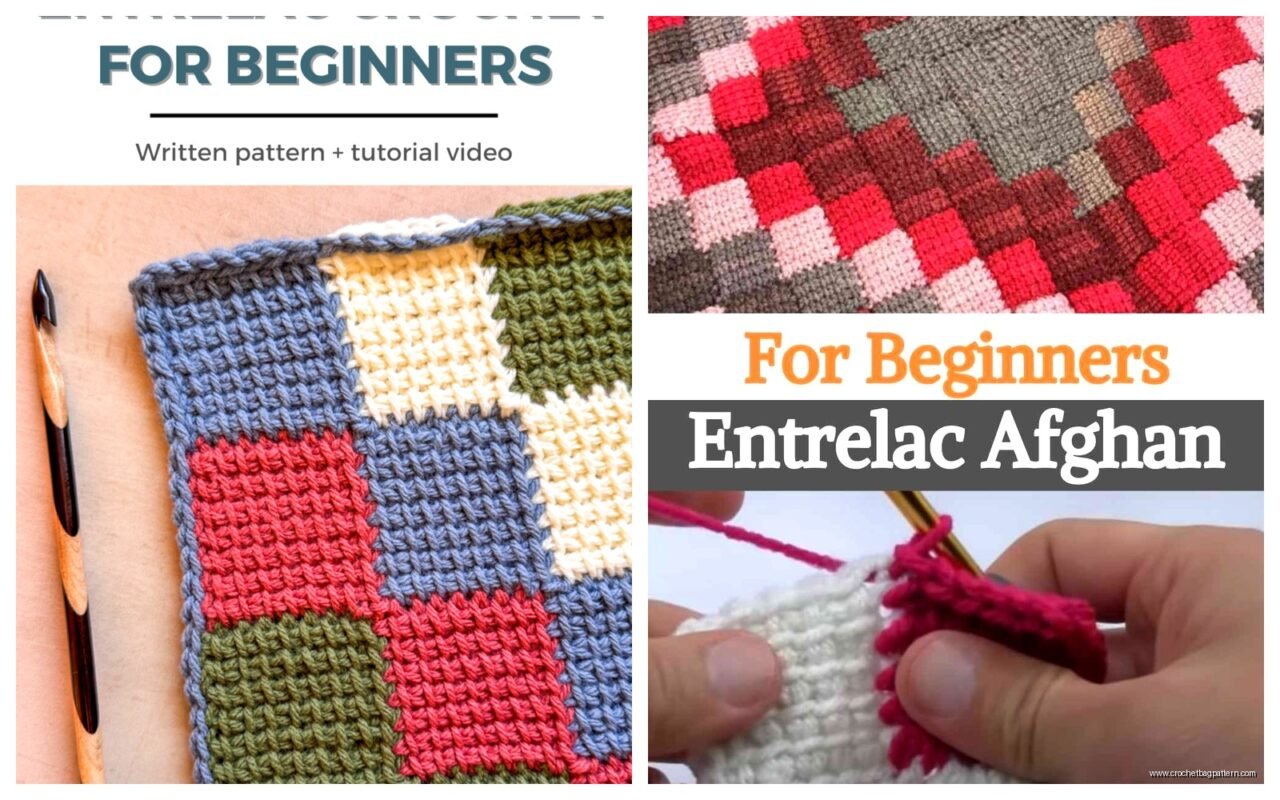
So entrelac looks super complicated but it’s honestly just making a bunch of small squares or rectangles that connect to each other as you go. I first tried this technique in spring 2022 when I was making a blanket for my sister and wanted something that looked more interesting than just regular rows. The whole woven look happens because you’re basically picking up stitches along the edges of blocks you already made.
You’re gonna need to know how to do basic double crochet and how to pick up stitches along an edge. That’s really it. The pattern works by creating these diamond-shaped blocks that fit together like tiles. Start with a foundation row of small triangles, then build rectangular blocks on top of those, and if you want clean edges you finish with triangles again at the top.
Foundation Triangles
For the base row you make small right triangles. Chain however many stitches you want for one block width – I usually do about 8 chains per block. Then you work back and forth in that first triangle, adding one more stitch each row until you have a full triangle shape. So like, row 1 might be 2 dc, turn. Row 2 is 3 dc, turn. Row 3 is 4 dc. You keep going until the triangle is as wide as your starting chain count.
Then without breaking your yarn you start the next triangle right next to it. Same process. This part is tedious but you just gotta push through. I made a scarf using Red Heart Super Saver in that tweedy gray color and the foundation row took forever because I was watching Succession and kept losing count.
Building the Rectangular Blocks
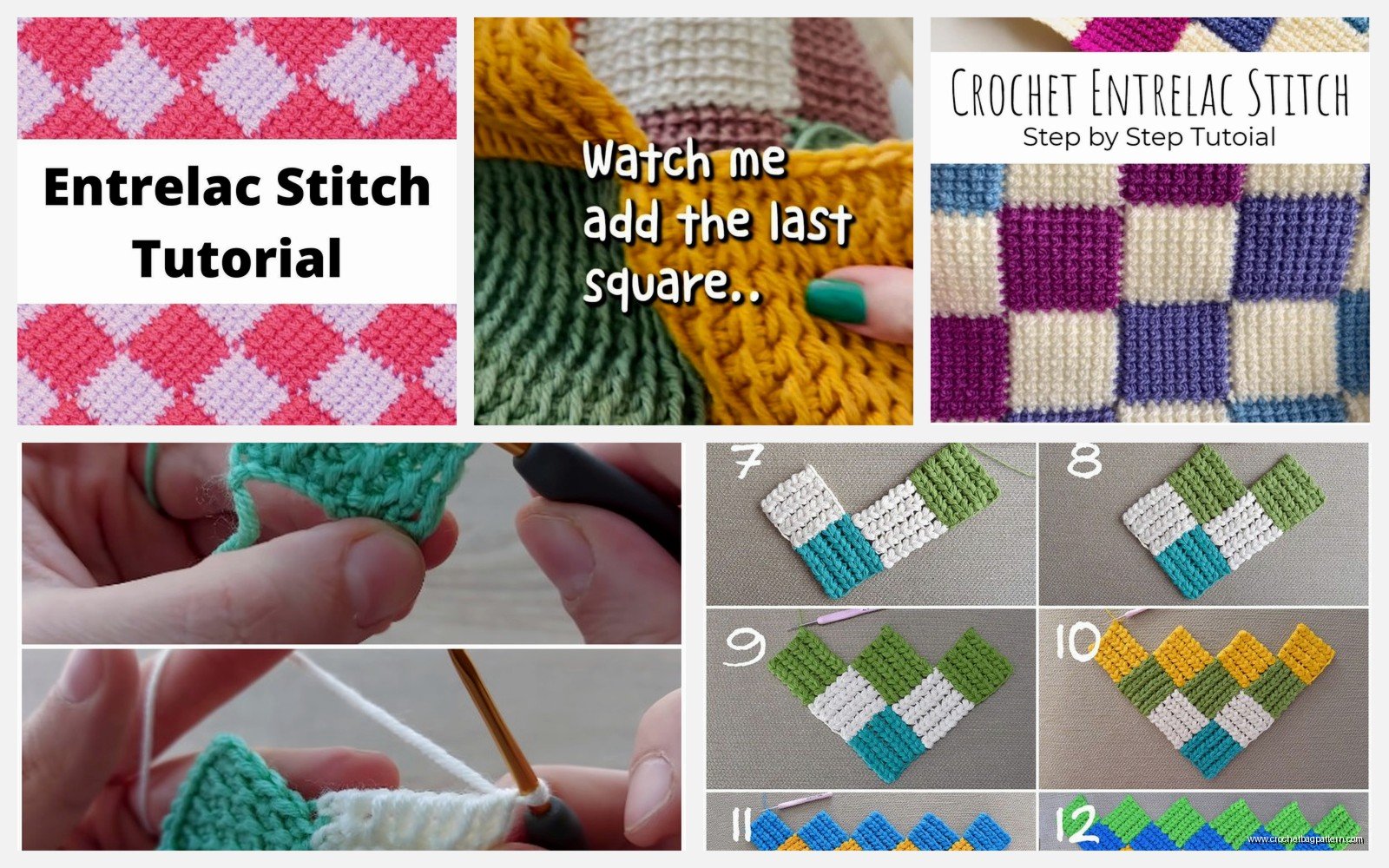
This is where it actually starts looking like entrelac. After your foundation triangles are done, you turn your work and start making rectangles that connect to the triangles below. You pick up stitches along the edge of a triangle, work across, then on the return row you join to the next triangle by working a stitch into its edge.
The way I do it is pick up like 8 stitches (or whatever your block width is) along the side edge of the first triangle. Work back across those stitches. Then on the next row, work almost to the end but leave the last stitch unworked, instead you slip stitch or sc into the edge of the adjacent triangle. Turn and work back. Keep doing this until you’ve worked all the way down the side of that triangle.
One thing that really annoyed me about this process was how the tension got weird at the corners where blocks meet. Like you’re trying to pick up stitches evenly but sometimes the edge is tight or loose and your blocks end up slightly different sizes. I learned you kinda have to fudge it sometimes and add or skip a stitch to make things line up properly.
The Back and Forth Pattern
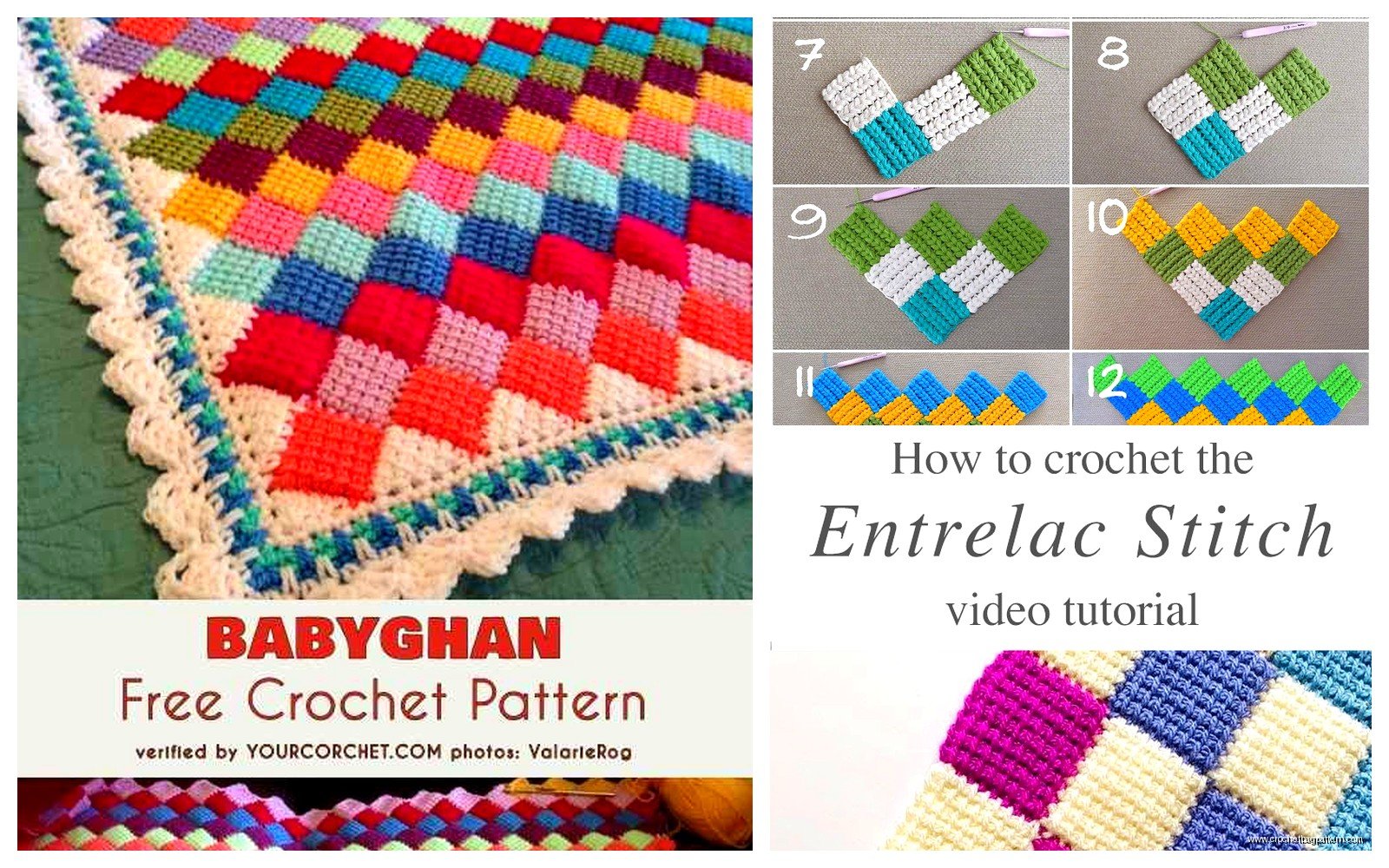
Once you finish a rectangle on one side, you move to the next triangle/block over and repeat. You work your way across the entire row making these rectangles. Then when you get to the end, you turn everything and work back in the other direction, making another row of rectangles that connect to the ones you just made.
The blocks naturally create this woven basket look because they’re oriented in different directions. Row 1 rectangles go one way, row 2 rectangles go perpendicular, row 3 matches row 1 again. That’s what makes the pattern.
Color Changes and Yarn Choices
Entrelac looks really cool with color changes. You can change colors every row of blocks, or every other row, or do random blocks in different colors. I used Caron Simply Soft for a baby blanket in summer 2024 and did stripes – two rows of cream, two rows of that soft blue color they have, two rows of gray. The color changes happen naturally when you start a new row of blocks so you don’t have a million ends to weave in.
Actually that’s not true, you still have a decent amount of ends but not as bad as if you were changing colors randomly within blocks. I usually weave them in as I go because I hate doing it all at the end.
Yarn weight matters for this technique. Worsted weight is easiest because the blocks are big enough to see what you’re doing but not so big that the project takes forever. I tried it once with fingering weight yarn and wanted to throw it across the room. The blocks were tiny and picking up stitches along those small edges was – well anyway I wouldn’t recommend going thinner than DK weight unless you have way more patience than me.
Practical Projects That Actually Work
Scarves are probably the best first project because they’re narrow so you only make like 2-3 blocks across. You get to practice the technique without committing to something huge. I made one that was just two blocks wide and it worked up pretty quick.
Blankets take forever but look impressive. The one I made for my sister was about 6 blocks wide and maybe 12 rows of blocks long. Used Lion Brand Vanna’s Choice because it was on sale and I needed a lot of yardage. Took me like three months of off and on work. My cat kept laying on it while I was trying to count stitches which was super helpful.
Bags can work if you make a flat rectangle and then seam the sides. The structure of entrelac is pretty sturdy so it holds shape well. Haven’t tried a sweater but I’ve seen patterns for them – seems like it would be heavy though since entrelac creates a pretty thick fabric.
Common Problems and How I Deal With Them
The edges can get wonky. Like the side edges of your project where you’re starting and ending rows of blocks. Some people do edge triangles to keep everything straight but honestly I usually just single crochet around the whole thing at the end to clean it up. Not technically correct but it works.
Counting stitches when picking up along edges is annoying because sometimes the edge stitches are stretched or tight and you can’t really see them clearly. I just eyeball it mostly and try to space them evenly. If I’m supposed to pick up 8 stitches, I mentally divide the edge into 8 sections and grab one stitch from each section. Close enough.
Tension consistency between blocks is hard. Some of my blocks turn out slightly bigger or smaller than others even when I’m trying to keep everything the same. Using a consistent hook size helps but I think it’s also just part of the handmade look. Nobody’s gonna measure your blocks with a ruler.
The Pick Up Stitch Method Details
There’s different ways to pick up stitches and I’ve tried a few. Some people insert the hook under both loops of the edge stitch, some go under just one loop, some go into the spaces between stitches. I usually go under both loops because it feels more secure but sometimes that makes the edge too tight so then I go through just the back loop or even through the space.
You can pick up stitches by chaining up and then working across, or you can pick them up already as double crochets. The second way is faster but requires more coordination. I chain up first when I’m watching TV and need to not think too hard, and I pick them up as dc when I’m actually paying attention.
Variations on Basic Entrelac
You can make the blocks different sizes within the same project which creates a cool irregular look. Like some blocks might be 6 stitches wide and some might be 10. Just gotta plan it out a bit so things still fit together.
There’s also tunisian crochet entrelac which uses a long hook and different stitches but creates a similar woven block effect. Haven’t really gotten into that because I don’t wanna buy a special hook but it looks interesting.
Some patterns have you work in the round to make entrelac cowls or even hats. The concept is the same but you’re joining the last block to the first block of each round. Seems fiddly but I might try it eventually.
Actual Pattern Example
Here’s basically how I make a simple scarf that’s two blocks wide. Foundation row is two triangles. Start with a slip knot, chain 9. Row 1: dc in 4th chain from hook, dc in next chain (3 dc total counting the starting chain-3 as a dc), turn. Row 2: ch 3, dc in each stitch across plus one more dc in the base of the turning chain from previous row (4 dc), turn. Keep increasing by one stitch each row until you have 8 dc plus the turning chain.
Don’t cut yarn. Chain 3, skip a few chains over to where the next triangle starts, and repeat the same increasing process for triangle 2.
First row of rectangles: Turn work so you’re working along the side edge of triangle 2. Pick up 8 stitches evenly along that edge by inserting hook under edge stitches and pulling up loops, then yarn over and pull through to make a chain. Once you have 8 picked up stitches, ch 3 and dc across all of them. Turn. Ch 3, dc across but on the last stitch, skip it and instead slip stitch into the edge of triangle 1. Turn and dc across again. Keep going back and forth, joining to triangle 1 on every right side row, until you’ve worked down the whole edge of triangle 1.
Now you’re at the end of the row with one rectangle complete. Pick up stitches along the other edge of triangle 1 and make another rectangle, this time joining it to the side of the rectangle you just made. Then you have two rectangles in that row.
Turn the work and make another row of rectangles going back the other direction, picking up stitches from the top edges of the rectangles below. Just keep going until the scarf is as long as you want.
My Honest Take on Time Investment
Entrelac is slower than regular crochet rows. Just is. All the turning and picking up stitches and joining adds time. That scarf I mentioned took me probably 15-20 hours for something that would’ve been maybe 8 hours in regular double crochet rows. But it looks way cooler so there’s that tradeoff.
The blanket for my sister took like 50+ hours I think? I wasn’t really tracking but it was my main project for months. Used probably 8 or 9 skeins of yarn.
If you’re making something as a gift, people who don’t crochet will probably not understand how complicated entrelac is compared to regular crochet. They’ll just think “oh nice blanket” same as they would for any blanket. Which is fine but also slightly annoying when you’ve spent hours doing this fiddly technique.
When Entrelac Makes Sense
Use this technique when you want texture and visual interest without doing complicated stitch patterns. It’s all just double crochet basically but looks intricate. Good for using up yarn stash in coordinating colors too since you can do each row of blocks in a different color.
Also works well when you want a thick sturdy fabric. The way the blocks overlap creates almost a double layer effect in some spots so it’s warm and has good structure. That bag idea I mentioned earlier would actually be perfect for this.
Don’t use entrelac for things that need drape. It’s not gonna flow nicely. Stick with structured items.
The woven look is really satisfying once you get the hang of it and honestly after the first few blocks the process becomes pretty meditative even with all the turning and picking up stitches. You just get into a rhythm with it.
